New Families Start Here

Never played field hockey? Neither had most of our players.

If you are wondering whether your child is too far behind to start, the honest answer is no. This is a brand new sport in Birmingham, which means almost every player is starting at the same place. That is the opportunity.

This page is the parent version. Read it once and you will follow most of what happens on the field, and most of what the umpire whistles for.

The 60-second version

Eleven players a side, a goalkeeper and ten field players, on a field 100 yards long and 60 wide. Both teams are trying to get the ball inside the painted D in front of the other goal, because a goal only counts if an attacker touches it inside that circle. That one rule shapes everything else you will watch.

The thing to know first: there is no offside in field hockey. It was removed from the sport in 1998. Players can stand anywhere on the field at any time. If you are used to soccer, stop looking for it.

Youth play days are often short sided, seven a side on a smaller field. Same rules, more space, and far more touches for every player. That is exactly why the format suits beginners.
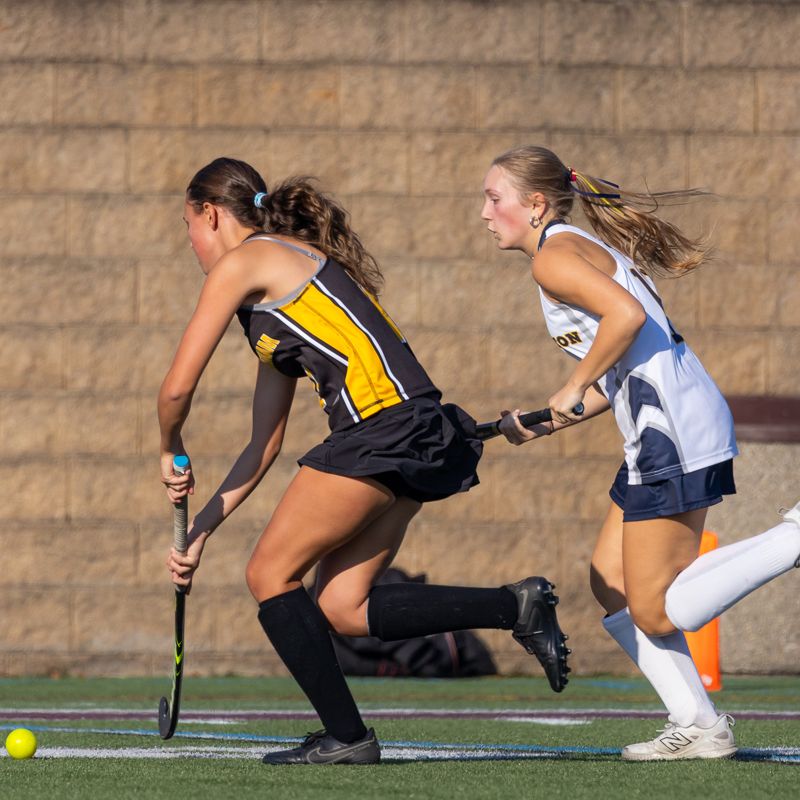
Birmingham field hockey player

The Rules

Six rules explain most whistles

Flat side onlyA field hockey stick has one flat face and one rounded back. Playing the ball with the rounded side is a foul, every single time. New players do it constantly, and that is normal.
No feet, no bodyField players cannot stop or steer the ball with a foot, a leg or any part of the body. Only the goalkeeper can, and only inside the circle. Umpires usually let accidental contact go if it gave nobody an advantage.
No shieldingThis is called obstruction, and it is the rule parents find strangest. A player may not stand still and use their body or stick to keep a defender away from the ball. Receiving with your back to a defender is fine as long as you turn and go.
Keep it safeLifting the ball toward another player, swinging the stick high near someone, or hitting into a crowd is dangerous play. At this level umpires blow it early and often, and that is a good thing.
Five yardsOn most fouls the other team gets a free hit and everyone else backs off about five yards. The player taking it may tap the ball to themselves and dribble away. That is called a self pass and it is legal.
The circle rules allA goal has to be touched by an attacker inside the D, 16 yards out. This is why players work so hard to carry the ball in rather than shoot from distance.

Who Stands Where

Positions on the field

A common 4-3-3 shape, attacking left to right. Our goal is on the left.

GK LB CB CB RB LM CM RM LW CF RW OUR GOALATTACKING GOAL 25 YD25 YDTHE CIRCLE
PositionWhat the job isWhat a good game looks like
Goalkeeper
GK
The only player allowed to use feet and body, and only inside the circle. Wears full pads.Stays big and stays on their feet. Clears wide rather than back into the middle. Talks to the backs all game.
Backs
LB, CB, RB
The last line before the goalkeeper. Sometimes called defenders or fullbacks.Clears the ball wide and away, never up the middle. Gets goal side of their player.
Midfielders
LM, CM, RM
Also called links or halves. They run the most on the field, defending and attacking in the same shift.Keeps moving after passing. Gets back on defense without being told.
Wings
LW, RW
Stay wide near the sidelines to stretch the other team out.Holds the width instead of drifting into the middle. Looks up before crossing.
Center Forward
CF
Lives at the top of the circle looking for deflections and rebounds.Stays inside the circle and gets a stick on anything that comes across. Most goals at this level come from here.
SweeperA back who plays behind the other backs as a safety net.You will hear the word even when nobody is formally assigned to it.

On the Whistle

The calls you will hear

CallWhat just happenedWhat happens next
Free hitAn ordinary foul somewhere on the field.The other team restarts from that spot. Everyone gives five yards. A self pass is allowed.
Penalty corner
short corner
A defender fouled inside their own circle, or committed a deliberate foul inside their own 25.One attacker pushes the ball in from the backline, 10 yards from the post. Five defenders and the goalkeeper wait behind the backline. The ball must travel outside the circle and come back in before anyone can shoot. The biggest scoring chance in the sport.
Penalty strokeA foul that stopped a goal that probably would have gone in.One attacker against the goalkeeper from seven yards. One touch, no backswing, no run up.
Long hit
corner
A defender accidentally sent the ball over their own backline.The attacking team restarts near that corner and comes straight back at the goal.
16 yard hitAn attacker sent the ball over the backline, or fouled inside the circle.The defending team restarts with a free hit 16 yards out from the goal.
AdvantageThe umpire saw a foul, but stopping play would have punished the team that was fouled.Nothing. You will hear "playing on" and the game continues.
Green cardA warning with teeth.That player sits out briefly, usually two minutes, and the team plays a person short.
Yellow cardA serious or repeated offense.That player sits out at least five minutes. The team plays short the whole time.
Red cardRare, and serious.That player is out for the rest of the game and the team stays short.

Based on the USA Field Hockey and NFHS rule set that Michigan schools play under, and the FIH Rules of Hockey. Youth play days sometimes run modified versions, and the umpire on the day has the final word.

From the Sideline

What to watch for

Signs it is going well

Players calling for the ball out loud. Two hands on the stick with the head low. Moving into space after passing instead of standing and watching. Backs clearing wide to the sideline. Somebody at the top of the circle whenever the ball goes in.

Normal first season things

Playing the ball with the back of the stick. Bunching around the ball instead of holding position. Swinging too hard and missing. Standing still to receive rather than moving to meet the ball. Lots of whistles.

What helps most

Cheer for effort and for hustle back on defense. Leave the officiating to the umpire. In a first year program every whistle is a teaching moment, and the players are still learning what the whistle meant.

Watch It Instead

Fifteen minutes of video

These point at searches rather than single videos on purpose, because individual videos get taken down and links rot.

USA Field Hockey

The national governing body, and the same organization whose membership every player carries. Rules explainers, skills and national team play.

Open the Channel

FIH Official

The world governing body. Full match replays and Olympic highlights. The best place to see the sport played properly.

Open the Channel

The Words

Glossary

The circle, or the D
The painted half circle in front of each goal, 16 yards out. Goals only count from inside it.
The 25
The line a quarter of the way down the field from each backline. A deliberate foul by the defense inside their own 25 earns the attacking team a penalty corner.
Push pass
The ball is pushed along the ground with the stick already touching it, no backswing. The first pass a beginner learns.
Hit
A full swing with both hands together at the top of the stick. Long and powerful, less accurate. Backs use it to clear.
Sweep
A low flat swing that keeps the stick along the ground. Faster than a push and safer than a hit.
Flick
A push that deliberately lifts the ball off the ground. Legal on a shot at goal and on a penalty stroke, dangerous anywhere near another player.
Reverse stick
Turning the stick over to play the ball on your left side while still using the flat face. It looks wrong and it is completely legal.
Tackle
Taking the ball off an opponent with the stick. Contact with the player, or hitting their stick, is a foul.
Jab
A quick one handed poke at the ball to disrupt a dribble. A defender's first move.
Deflection or tip
Redirecting a moving ball rather than striking it. Most goals from the top of the circle are deflections, not shots.
Trap
Stopping a moving ball dead with the stick so the next touch is clean. The most useful skill to practice at home.
Inserter
The player who pushes the ball in from the backline to start a penalty corner.
Pinnie
The numbered team top worn over a practice shirt. Birmingham provides them and collects them at the end of the season, so there is no uniform to buy.
Bully
A restart where two players tap sticks over the ball. Rare now, used mainly when play stopped with no clear fault.
Short sided, or 7v7
A game with fewer players on a smaller field. Same rules, more space, far more touches each. Common at youth play days.

Questions

Parent FAQ

Do they need any experience?
None at all. Both fall programs are built for brand new players, and most of our players picked up a stick for the first time this year.
What grades can join?
The pathway runs grades 3 through 12: a grades 3–5 Learn to Play clinic, a grades 6–8 middle school team, and Birmingham United high school field hockey.
Does my child have to attend a Birmingham school?
For the grades 6–8 middle school team, yes. League play requires that your player attends a Birmingham middle school. The grades 3–5 Learn to Play clinic is open to players from neighboring communities as well.
How much does it cost?
Middle school, grades 6–8, is $200 for the fall season. Learn to Play, grades 3–5, is $85 for five Sundays. See the Programs page for what each one covers.
Is it safe?
Field hockey is a non contact sport, and the rules are built around keeping the ball and the stick down. Players wear a mouthguard and hard field hockey shin guards at every session. Goggles are optional, with one exception: the defensive corner unit always wears them during a game. Lacrosse goggles are fine. At this level umpires call dangerous play early and often, which is exactly what you want while everyone is learning.
Can they play field hockey and another sport?
Yes. Many of our players also play soccer or lacrosse. Missing some practices is not a problem, and no player loses their place for it.
Do we need a USA Field Hockey membership?
Yes. Every player needs a current USA Field Hockey membership before registering. The State Chapter level is all you need, and you select Great Lakes as your team affiliation. You will enter your membership number when you register. Get it here.
What do they need to bring?
A stick, hard field hockey shin guards, a mouthguard and water. Players also need an all black skort or plain black shorts for games, and both pairs of socks, white and black, long enough to cover shin guards. Pinnies are provided. See the equipment guide before you buy anything, because shin guards are the item families get wrong most often.
How do I sign up?
Registration for the 2026 fall season closed on Sunday, September 20. When sign-ups open again, registration and payment run securely in one form and take about five minutes. Join the interest list and we will email you when that happens.
How will we get team information?
GroupMe is the channel for grades 3 through 8. Field changes, weather calls and arrival times go there. You will be added after you register.

Ready to try it?

Fall 2026 registration is closed. Join the interest list and we will email you when sign-ups open for the next season.

Join the Interest List